
The Art of the Silent Clash: How Festival Sound Crews Stop Stages From Bleeding Into Each Other

The Art of the Silent Clash: How Festival Sound Crews Stop Stages From Bleeding Into Each Other
The Art of the Silent Clash: How Festival Sound Crews Stop Stages From Bleeding Into Each Other
The Invisible Boundary Between Acoustic Serenity and Bass Demolition
Picture the classic festival contrast: a singer-songwriter is shaping a fragile melody on one stage while, a few hundred feet away, another crowd is moving to a bass line powerful enough to feel through the soles of its shoes. On a well-run site, the acoustic set remains intimate. The kick drum next door does not turn every pause into a low-frequency rumble, and the vocal does not arrive as a ghostly echo over the dance floor. That separation can feel almost magical, but it is anything but accidental.
Sound bleed is one of the hardest problems in large-scale live production because music does not respect the neat borders drawn on a festival map. Low frequencies travel broadly, wind can carry high-energy sound across open ground, and audiences move through constantly changing acoustic environments. The solution is a carefully coordinated blend of physics, architecture, loudspeaker design, digital processing, environmental monitoring, and stagecraft. Every clean transition between stages reflects decisions made long before the first artist walks onstage.
Smart Site Geography and Acoustic Zoning
The first sound-control tool is often the landscape itself. Festival planners study slopes, hollows, treelines, existing buildings, service roads, and raised earthworks before deciding where stages should stand. A natural berm can block or redirect part of a sound field. A dense treeline may provide useful visual and psychological separation, although vegetation alone is rarely enough to stop powerful low frequencies. The most effective sites combine these passive features with speaker orientation and distance.
Stage geometry matters just as much. Two stages aimed directly toward each other create an obvious collision course, especially when both systems are operating at high levels. Designers therefore tend to place stages back-to-back, offset them, or position them perpendicular to one another. This allows each loudspeaker system to project toward its intended audience while reducing the amount of direct energy aimed at the neighboring performance area. The final arrangement also considers backstage structures, generator compounds, food courts, and camping areas, since these spaces can either absorb, reflect, or unintentionally funnel sound.
The routes between stages are part of the acoustic plan too. A walkway that leads through trees, behind a production compound, or across a wider open zone can function as a transition buffer. That gives the ear time to move from one sonic environment to another instead of forcing a sudden collision between competing mixes. Research and festival planning guidance increasingly treat pathways as part of the audience experience, because movement affects fatigue, crowd density, and the way visitors encounter sound. For fans, festival map hacks can reveal more than shortcuts: they can show where sound fields converge, where quieter reset areas may sit, and which route is likely to offer the smoothest transition between sets.
- Look for stages positioned at angles rather than directly opposite each other.
- Use treelines, berms, buildings, and wide open spaces as clues to the site”s acoustic zoning.
- Treat quieter paths and shaded areas as listening buffers, not merely routes between performances.
- Expect the most noticeable bleed near stage edges, crossover walkways, and open perimeter areas.
Taming the Subwoofer Monster with Cardioid Bass Arrays
Low-frequency energy is the most persistent enemy of stage separation. Bass wavelengths are long, and subwoofers radiate energy much more broadly than the high-frequency components that carry cymbal detail, vocal consonants, and guitar sparkle. A bass system can therefore reach far beyond the area where the audience perceives the main speakers as loud. Without control, one stage”s sub-bass can become another stage”s unwanted soundtrack.
Cardioid subwoofer arrays are designed to reshape that behavior. Instead of placing every subwoofer in a simple forward-facing row, engineers arrange cabinets with carefully calculated spacing and sometimes reverse the orientation of selected units. In a typical setup, rear-facing or physically offset elements receive inverted polarity and a precisely chosen digital delay. The sound waves combine constructively toward the audience and destructively behind the array. Timing is critical because cancellation only works when the arriving waves have the right phase relationship at the frequencies being controlled.
The result is a forward-focused bass pattern with a substantial rear rejection zone. It is not a silent wall, and no cardioid arrangement works identically at every frequency or audience position. Ground reflections, cabinet spacing, stage decking, and nearby structures all affect the outcome. Still, the technique can sharply reduce the amount of low-frequency energy washing toward a neighboring stage while preserving the physical impact that makes a live electronic, hip-hop, rock, or pop set feel immediate. Modern loudspeaker systems also integrate controlled directivity into broader array designs. For example, the d&b V12 loudspeaker uses a symmetrical low-frequency arrangement and maintains constant horizontal directivity through part of the low-mid range, helping engineers build consistent coverage rather than relying on brute volume.
| Control decision | Why it matters |
|---|---|
| Cabinet spacing | Determines the phase relationship and the frequencies where directional control is strongest. |
| Polarity reversal | Helps create destructive interference in the rearward direction. |
| Digital delay | Aligns wavefronts so forward reinforcement and rear cancellation occur at the intended positions. |
| Array orientation | Sets the direction in which bass energy is projected across the audience. |
| On-site tuning | Compensates for reflections, ground conditions, stage structures, and changing audience geometry. |
Line Arrays and Precision Sonic Beam Steering
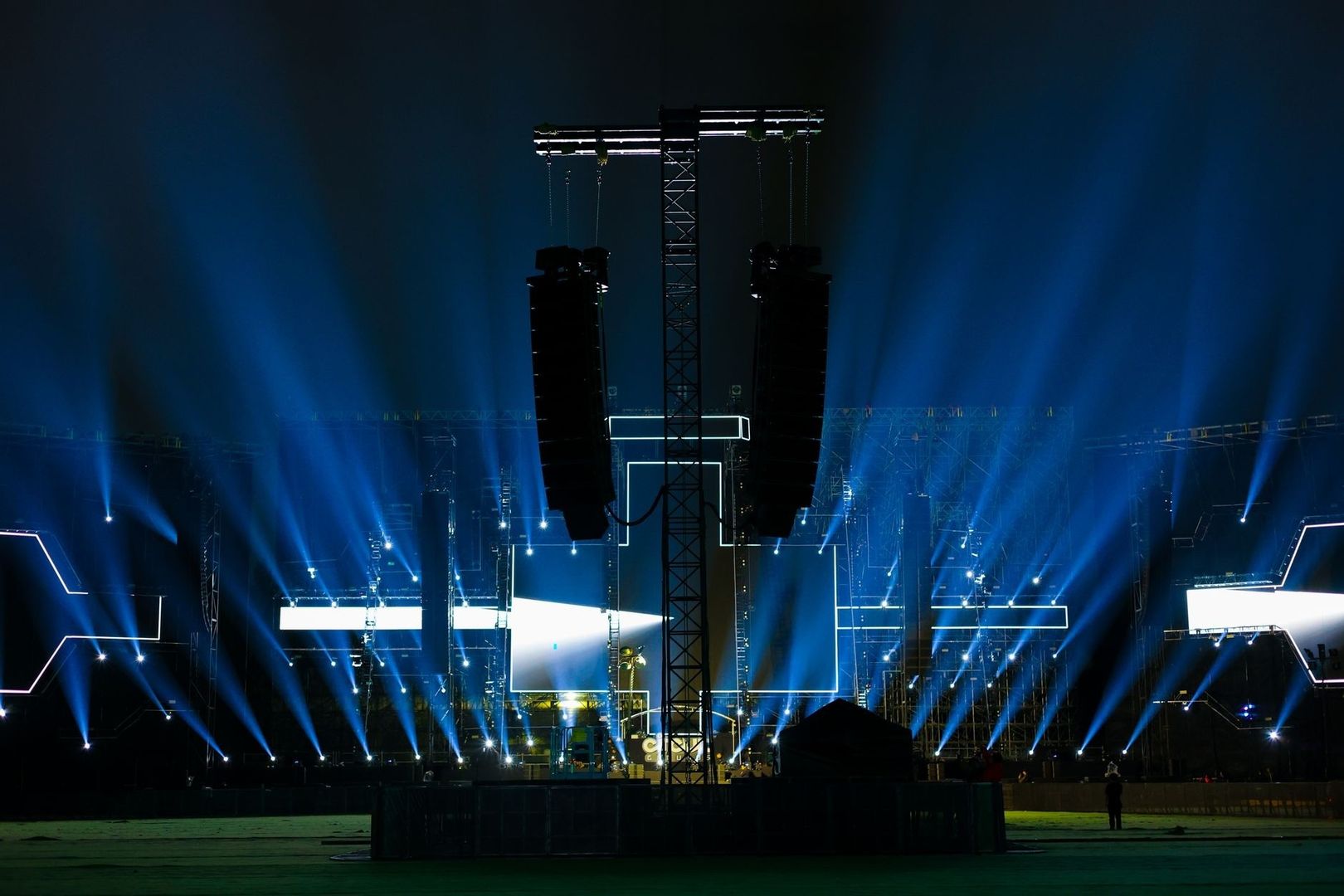
Older festival systems often depended on point-source loudspeakers, with each box spreading sound broadly from a single location. That approach can work in smaller venues, but large outdoor audiences demand more control. Line arrays use multiple cabinets arranged vertically so their outputs interact as a coherent wavefront. The system can project farther, maintain more consistent coverage across the audience, and reduce unnecessary energy above and beyond the target listening area.
The cabinet angles are not chosen by guesswork. Array prediction software models the stage, audience depth, trim height, enclosure characteristics, and desired coverage. Engineers then adjust inter-cabinet angles so the upper part of the array reaches distant listeners while lower sections address people close to the stage. Digital signal processing fine-tunes equalization, delay, limiting, and crossover behavior. The goal is not simply maximum volume. It is a controlled sound-pressure map in which the front, middle, and rear audience areas receive a balanced musical image.
Vertical directivity is especially useful when neighboring stages, hospitality areas, or residential boundaries sit beyond the audience. By steering the main energy downward, engineers can deliver high sound pressure to listeners while reducing the amount that escapes over the perimeter. The PreSonus CDL12P constant-directivity system, for instance, combines a point-source woofer with multiple high-frequency drivers and offers controlled horizontal and vertical coverage that can be expanded through arrays. Larger touring systems apply the same general principle at greater scale, using prediction, rigging geometry, and system processing to make every cabinet contribute to a defined coverage plan.
- Upper array elements serve distant audience zones and are often aimed closer to the horizon.
- Lower elements are angled downward to cover nearby listeners without throwing excess energy beyond the crowd.
- Digital delays align cabinets and supplementary fills so the audience hears one coherent system.
- Side fills and front fills close coverage gaps while being kept as low and focused as practical.
Live Decibel Monitoring and Real-Time Environmental Battles
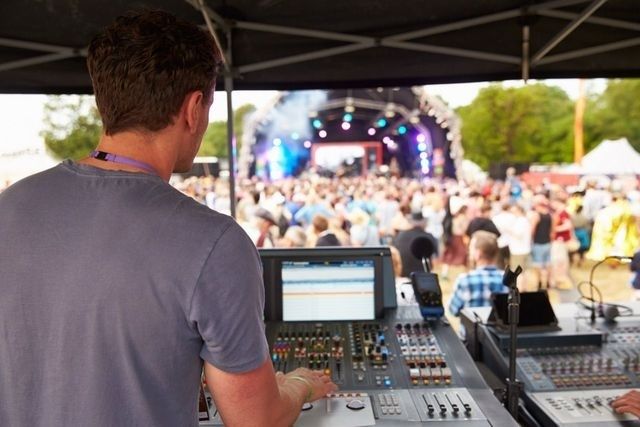
Even a carefully designed system must respond to changing conditions. Festival sound teams use networked measurement points at front of house, around the audience perimeter, and sometimes at nearby sensitive locations. These systems can track overall sound levels as well as frequency-specific information. Third-octave analysis is particularly useful because it shows whether a problem is concentrated in sub-bass, low-mid energy, or a narrower band that may be traveling more effectively through the site.
Weather can alter the result from one set to the next. Wind may carry sound toward a residential boundary or push it away from one stage and into another. Temperature inversions can bend sound back toward the ground, making distant music unexpectedly audible. Humidity changes the absorption of high frequencies, while wet ground and hard temporary surfaces influence reflections. A mix that behaved responsibly during a warm afternoon can therefore require adjustment after sunset, when atmospheric layers become more stable and long-distance propagation increases.
Professional monitoring is a coordinated operation rather than a single meter watched by one technician. Acoustic consultants, production managers, stage sound engineers, venue representatives, and local authorities may work from agreed limits and communication protocols. Guidance for festival acoustic consultancy commonly includes pre-event surveys, predicted off-site levels, licensing coordination, continuous or scheduled monitoring, and a clear process for responding to complaints. During the event, the workflow typically follows several linked steps:
- Measure sound at front of house and selected control points around the site.
- Compare current levels and frequency content with the agreed limits for each time period.
- Identify whether the cause is the main system, subwoofers, side fills, stage orientation, or environmental propagation.
- Coordinate adjustments between stages, such as reducing a subwoofer band, changing delay timing, or lowering overall output.
- Record the change and continue monitoring to confirm that the correction works without damaging the audience mix.
This is why festival sound restrictions do not necessarily mean weak sound. A capable team can preserve punch, clarity, and musical detail by targeting the frequencies and directions that create the problem. The loudest possible system is rarely the best system. The best system is one that feels powerful where the audience stands, remains intelligible across the listening area, and behaves responsibly beyond the boundary.
Step Into Your Next Festival With Golden Ears
The next time a delicate vocal survives beside a wall of dance music, listen for the hidden structure behind the moment. Stage placement may have separated the projection paths. Berms and trees may have created passive barriers. Cardioid sub arrays may be suppressing rearward bass, while a precisely splayed line array keeps high-frequency detail inside the intended audience zone. Behind it all, technicians are checking measurements, watching the weather, and exchanging updates across the production network.
Festival-goers can spot some of this craft without entering the production compound. Notice the line of subwoofers beneath a stage, the angle of the main hangs, the way stages face across the site, and the quieter corridors between high-energy areas. These details reveal a festival built not only for spectacle, but for sustained listening. The invisible sound crews rarely receive the same applause as the artists, yet their work protects every vocal entrance, bass drop, guitar shimmer, and shared crowd moment. Pristine festival sound is engineered silence between stages, and that silence is what lets each performance claim its own space.
